.png)
Who Were The Pharisees?
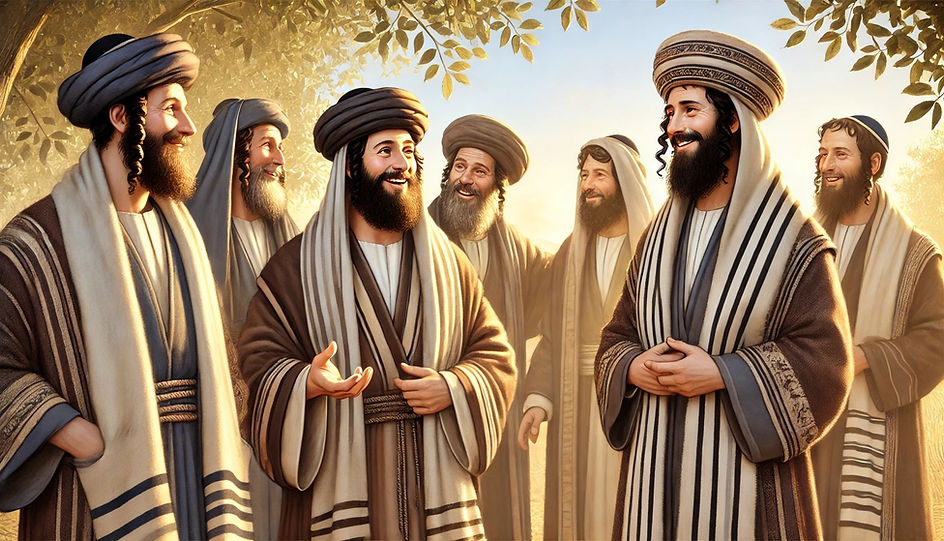
Chapter 1 "Rabbi Yeshua, Was He a Pharisee?"
Some Christian teachers do not teach that Yeshua was recognized by the Jewish community as a rabbi. Many Christians embrace the King James Bible which has errors in transliteration which "replace" Greek words which point to the Jewish culture. John 4:31 translate the Greek word for "rabbi" as "master" even though the Greek word is obviously "Rabbi". In John 3:1 they correctly transliterate the same Greek word as "Rabbi".
Rabbi (רַבִּי) in the first century was the honorific title given to a recognized teacher. After 70 CE, the movement that organized Jewish life around study and halacha emerged from the Pharisees, and within that movement, “rabbi” became a formal title. That later development matters because, even before 70 CE, Yeshua is repeatedly addressed as rabbi, and once with the heightened Aramaic form "my rabbi". The title “Rabbi” was used respectfully before 70 CE, as seen in the Gospels, but its formal use as an official title for ordained sages developed after the destruction of the Temple. The Jewish Encyclopedia connects the wider use of “Rabbi” with the generation of Rabban Yohanan ben Zakkai and his disciples, while Chabad notes that it became an official title in the second century. Hershel Shanks likewise argues that the Gospel use of “Rabbi” for Yeshua may reflect an earlier respectful usage before the later formal rabbinic title. Therefore, many readers place him in, or close to, the Pharisaic stream because the way it’s used signals the kind of teacher he was recognized as.
First, look at how consistently people address him as Rabbi. The public used the word when they approached him for guidance, explanation, or judgment, exactly the social role associated with Pharisaic teachers. John 3:2, Nicodemus, a Pharisee, comes by night and says, “Rabbi, we know you are a teacher who has come from God.”John 4:31; 6:25; 9:2; 11:8 Disciples and crowds speak to him as “Rabbi” while seeking teaching, food, clarification, and safety.
Second, notice who is using the word. Crowds say rabbi, and a Pharisee (Nicodemus) does as well. This matters because Pharisees valued learned teachers who interpreted Torah for daily life. When a Pharisee addresses Yeshua as rabbi, it again shows recognition within that world. Strong evidence that Yeshua’s public identity fit a Pharisee-shaped profile of a teacher. John 20:16 adds an especially tender and important witness. After the resurrection, Yeshua calls her by her Hebrew name, Miriam. The Greek text preserves the name as “Mariam,” reflecting the Hebrew name מִרְיָם. When she hears him call her name, she recognizes him and answers in the language of Jewish discipleship, “Rabbuni,” meaning “my Rabbi” or “my Teacher.” This is not a cold title or a distant label. It is the personal cry of a Jewish disciple recognizing her Jewish teacher. The risen Yeshua is still known by the language of Torah, discipleship, and rabbinic relationship.
Third, consider the social function the title performs in these scenes. People come to the rabbi, Yeshua, to ask questions about scripture, ethics, and practice; they defer to his judgments; they expect him to expound the will of Hashem. That is precisely the public role Pharisaic teachers were known for in towns and synagogues. Consequently, the repeated address rabbi does more than flatter; it locates Yeshua in the familiar lane of a Pharisee whose authority rests on exposition and application.
Finally, and this is crucial, the later history of the word strengthens the inference. After the Temple’s fall, “rabbi” became the formal title of ordained sages in a movement that grew out of the Pharisees. Looking back from that development, it is easy to see why many conclude Yeshua’s contemporaries already perceived him in that mold: the man people called rabbi looks, sounds, and functions like the kind of teacher that Pharisaic Judaism prized.
In sum, the case is cumulative. Yeshua is addressed as rabbi again and again (and once Rabbuni), including by a Pharisee; those scenes show him doing what such teachers did; and the later, formal use of “Rabbi” arose in a Pharisee-rooted movement. Therefore, it explains why many people sensibly place Yeshua in or near the Pharisee lane.
I have just started on the "Who Were the Pharisees" book.
I am 75 years old, which isn't very impressive on a resume. I am also an artist. Any donation or an introduction to a pro-bono attorney to get a 501C status would be appreciated!