.png)
Who Were The Pharisees?
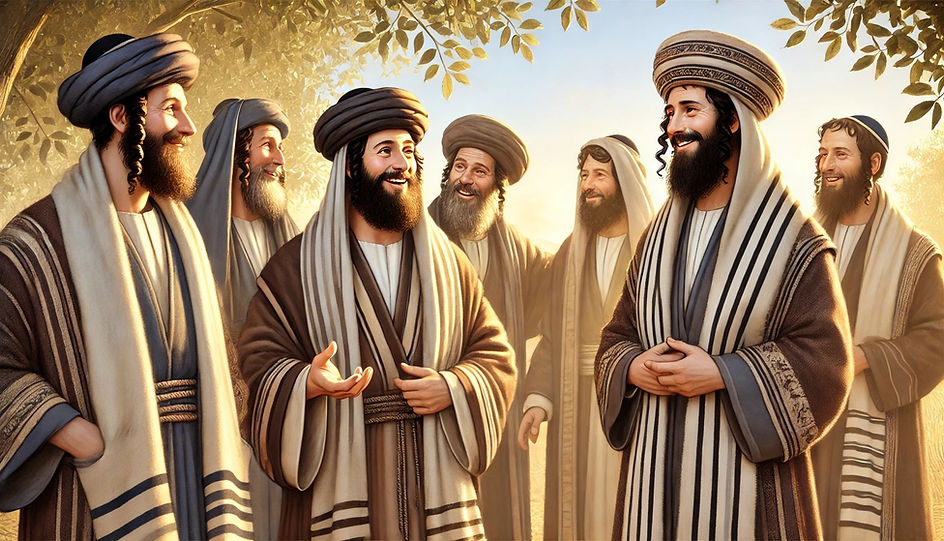
Chapter 3
Was “Sha’ul Saul/Paul a Pharisee?
Explores Paul’s identity as a Pharisee and how it shaped his ministry.
A Pharisee wrote a good percentage of the New Testament.
Sha’ul never forsook his Pharisaic identity. In Acts 23:6, he shouted that he was a Pharisee! He said, not that he "was" a Pharisee, but he said, "I am." Plus, Torah teachers who sided with the Pharisees were open to what Sha’ul said to them. Acts 23:9, “We don’t find anything wrong with this man; and if a spirit or an angel spoke to him, what of it?”
Sha’ul never stopped writing about Yeshua’s father, Almighty God. Philippians 4:13 is a good example. Some English Bibles read “through Christ,” while many critical Greek texts read more literally, “through the one who strengthens me.” He is saying that his strength comes from Yeshua’s father, the God of Israel. especially in the context of hardship, endurance, and contentment. Psalms 28 mentions that the father is a strength and shield.
Sha’ul’s teaching style was typical of Pharisaic reasoning.
As in Romans 4:1-3, Paul's teaching shares strong similarities with Midrashic interpretation—a traditional Jewish method of interpreting Scripture that draws out deeper meanings, often through creative engagement with the text.
Let's look at how Romans 4:1–3 fits into that.
“Then what should we say Avraham, our forefather, obtained by his own efforts?
For if Avraham came to be considered righteous by God because of his actions, then he has something to boast about. For what does the Tanakh say? ‘Avraham put his trust in God, and it was credited to his account as righteousness.’”
In Romans 4, Paul quotes Genesis 15:6 and then reasons from it. He does not merely quote the verse and move on. He draws out its meaning, showing that Abraham’s trust was counted as righteousness before circumcision and apart from works. Later rabbinic texts show the same kind of scripture-centered reasoning by question, citation, and interpretation. In Berakhot 10a, Berurya argues from the wording of Psalm 104:35, saying the verse points to the ending of sins rather than the death of sinners. In Nedarim 32a, the discussion asks why Abraham’s descendants were enslaved, and one answer reasons from Abraham’s question in Genesis 15:8. Bereshit Rabbah, a midrash on Genesis, also shows this habit of close reading as it moves carefully through the biblical text. These examples are later than Paul, so they do not prove that Paul borrowed from those books. They show that Paul’s method in Romans 4 belongs to a Jewish interpretive world where Scripture is quoted, questioned, and reasoned from carefully. Source note: Genesis 15:6, Romans 4:1–11, Berakhot 10a, Nedarim 32a, Bereshit Rabbah.
Genesis 15:6 (CJB) states, “He believed in Adonai, and He credited it to him as righteousness.” There was no sacrifice, and there were no works.
Romans 4:9–11 (CJB): “Now, is this blessing for the circumcised only, or is it also for the uncircumcised? For we say that Avraham’s trust was credited to his account as righteousness; but what state was he in when it was so credited—circumcision or uncircumcision? Not in circumcision, but in uncircumcision! In fact, he received circumcision as a sign, as a seal of the righteousness he had been credited with on the ground of the trust he had while he was still uncircumcised.”
Paul’s midrash-like logic builds a theological case that righteousness precedes works, something rabbis would also do, connecting layers of meaning from the order of events in Torah. Because righteousness precedes works, works are a fruit of righteousness. Sha’ul/Paul also wrote in Corinthians, "Being circumcised means nothing, and being uncircumcised means nothing; what does mean something is keeping God’s commandments.” God’s commandment to the Israelites was that his people were to be circumcised.
I have just started on the "Who Were the Pharisees" book.
I am 76 years old, which isn't very impressive on a resume. I am also an artist. Any donation or an introduction to a pro-bono attorney to get a 501C status would be appreciated!