.png)
Who Were The Pharisees?
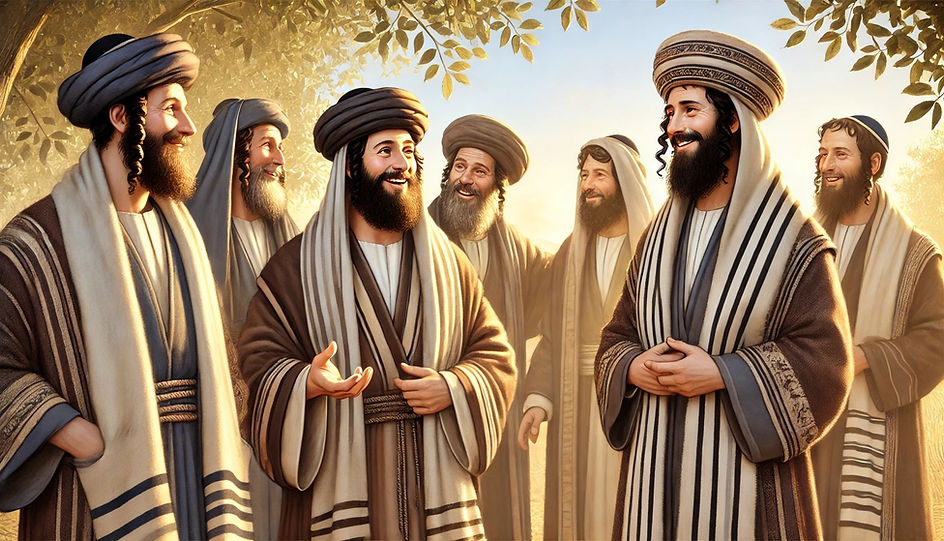
Chapter 2 Did Yeshua Rebuke All of the Pharisees and the Keeping of the Law?
Chapter 2 Examines Yeshua’s Attitude Towards the Torah (Law) and His Talmidim Learning from Pharisees
In my opinion, the relationship between Yeshua and the Pharisees is often misread because many Christian teachers focus almost entirely on conflict passages. Matthew 23 is usually treated as if it proves that Yeshua rejected the Pharisees as a whole, but the opening verses say something more careful and more important.
Read Matthew 23 slowly.
Matthew 23:1 says Yeshua spoke to the crowds and to his talmidim. That matters. He was not giving outsiders permission to despise Jewish teachers. He was instructing his own listeners on how to understand the authority of the Torah-teachers and the P’rushim.
Then Yeshua says that the Torah-teachers and the P’rushim “sit in the seat of Moshe.” This is a major statement. The seat of Moshe was not an insult. It referred to a recognized teaching role connected with explaining Torah to the people. Yeshua did not deny that role. He acknowledged it.
Matthew 23:3 is even more striking. Yeshua tells the crowds and his talmidim to do and observe what they are taught from Moses’ seat. In the Greek text, the verbs translated “do” and “observe” are imperative forms, which are the normal grammatical form for giving a command or instruction. This means Yeshua was not making a casual suggestion. He was telling his listeners to take seriously the teaching authority connected with Moses’ seat.
That is the part many people skip. Before the warnings in Matthew 23, Yeshua first recognizes the teaching position of the Torah-teachers and Pharisees. He does not say, “Ignore everything they teach.” He does not tell his disciples to leave the synagogue world. He does not tell them that Pharisaic teaching is worthless. Instead, he tells them to listen carefully where Torah is being taught from Moses’ seat.
This does not mean Yeshua agreed with every Pharisee or every opinion. Pharisees debated among themselves, and Yeshua debated within that Jewish world. But Matthew 23 begins with recognition, not rejection. The chapter makes much better sense when read as an internal Jewish correction, not as a Christian attack on Judaism.
The word “talmidim” is also important. Yeshua’s followers were not merely admirers. They were students, disciples, learners. In Matthew 23, the Rabbi is teaching his own talmidim how to respect legitimate Torah instruction while also discerning character and conduct. That is a very Jewish scene.
Therefore, Matthew 23 should not be used to erase the Pharisees from Yeshua’s world or to turn them into cartoon villains. The opening verses show that Yeshua recognized their role in teaching from Moses’ seat. For a book seeking to recover what is often ignored, Matthew 23:1–3 is essential. It shows Yeshua speaking as a Jewish Rabbi, to Jewish talmidim and crowds, about Jewish teachers whose authority he acknowledges before giving correction.
I have just started on the "Who Were the Pharisees" book.
I am 76 years old, which isn't very impressive on a resume. I am also an artist. Any donation or an introduction to a pro-bono attorney to get a 501 (c) (3) status would be appreciated!