.png)
Who Were The Pharisees?
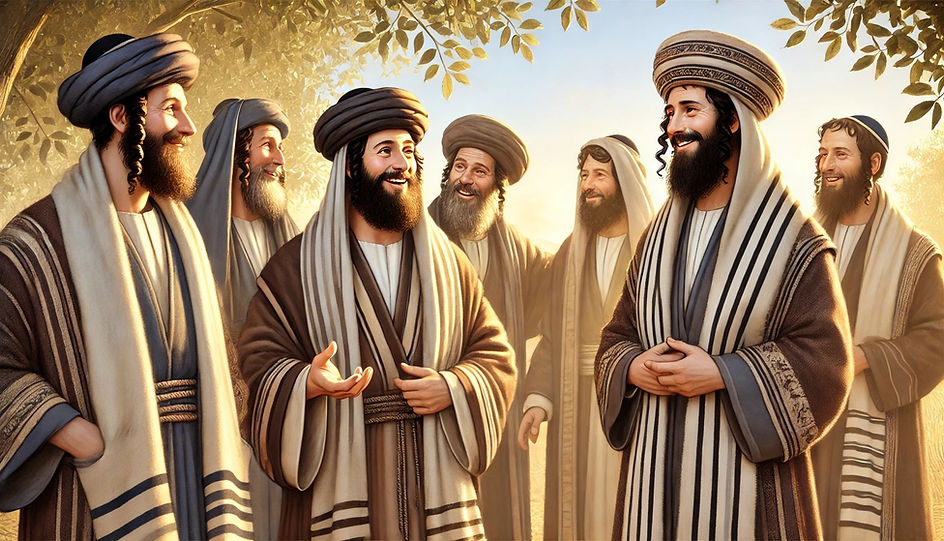
Pharisees and the Return of Yeshua
Before Christianity, a Pharisaic Hope
With all the crazy things going on in the world, there seems to be talk of the messiah returning. So, I am entering into the fray with some radical truth in the scriptures. I have never been "into" prophecy, so this chapter is taking me A LOT longer than my other chapters, but I was curious about this subject.
If you remove the Pharisees from the New Testament world, the return of Yeshua becomes a floating, de-Jewished idea, more like later religious mythology than Israel’s own covenant storyline. However, when you read return passages through Pharisaic categories, the language snaps into focus: resurrection, righteous judgment, authority rooted in scripture, and accountability measured by Torah. These are not random themes; they are the Pharisees’ signature disputes with the Sadducees and their signature commitments in public life.
1) Resurrection is not an add-on: it is the Pharisaic backbone of “return” hope
The most explicit Pharisaic fingerprint is the belief in resurrection. Acts records a direct line of controversy: Sadducees deny resurrection and the reality of angels/spirits, while Pharisees affirm them (Acts 23:6–8). The New Testament is standing in the Pharisaic stream of Jewish expectation.
Daniel and Isaiah don’t treat death as a loophole. They put resurrection and final accounting on the table (Dan. 12:2–3; Isa. 26:19). Therefore, life is not a one-act play, and Hashem’s justice doesn’t end at the cemetery gate.
2) “Coming on the clouds” is courtroom language, not a new Christian concept
One of the most quoted return statements in the New Testament is spoken in a legal setting. When questioned under oath by the high priest, Yeshua answers with the “right hand” and “clouds” imagery (Matt. 26:63–64). However, the key point for this chapter is not to re-argue the trial; it is to show what kind of Bible-world claim is being made.
That “clouds” language is Daniel’s vision of authority: “one like a son of man” comes with the clouds and receives dominion and a kingdom (Dan. 7:13–14). Moreover, the “right hand” language is Psalm 110’s enthronement scene: “Sit at my right hand…” (Ps. 110:1). Therefore, Yeshua’s “return” language is not imported imagery; it is a claim to stand inside Israel’s own courtroom of ultimate authority.
This is exactly where Pharisaic training matters. Pharisees were scripture arguers, public interpreters who recognized that authority claims must be made in scripture’s terms. So the return of Yeshua is narrated not as “new religion arrives,” but as “Israel’s promised authority arrives,” framed through Daniel and the Psalms.
3) Pharisaic accountability: judgment that matches Torah
Pharisaic piety wasn’t only a study; it was the conviction that Hashem judges human life by covenant standards. Therefore, return passages naturally sound like accountability passages. Yeshua’s parables about readiness and judgment do not land in a vacuum; they land in a Jewish world where judgment is expected to be righteous, measurable, and consistent with Hashem’s ways.
That Torah-shaped measurement is already the Tanakh’s pattern: Hashem judges with justice, defends the oppressed, and exposes false piety (Isa. 1:16–17). Moreover, the prophets repeatedly tie future hope to future justice; Hashem does not establish his reign without righteous judgment; he will judge the earth (Ps. 96:10–13).
So when Yeshua describes a final sorting and a final reckoning (for example, Matt. 25:31–46), a Pharisee would not hear “new moral system.” They hear the prophetic drumbeat: covenant obligations are real, hypocrisy is judged, and mercy and justice are inseparable. However, the critical Pharisee-centered point is this: the return does not cancel Torah; it intensifies accountability to Hashem’s standards.
4) Paul is the bridge of the return hope
Paul appears here only as a supporting witness. As a Pharisee, he located the future hope of resurrection and restoration inside Israel’s promises, not outside them. His point was not that a new religion had replaced Israel’s hope, but that the resurrection of Yeshua confirmed the hope already rooted in the prophets and debated in Jewish life. That keeps the return of Yeshua inside Israel’s own story.
5) What the Pharisees force us to say about the return
A Pharisee-centered reading forces several conclusions that many later readers resist:
-
The return is covenantal: it presupposes Hashem’s ongoing commitment to Israel and Israel’s Scriptures, not replacement (Jer. 31:31–37).
-
The return is judicial: it is public judgment in line with the prophets’ demands for justice (Isa. 1:16–17; Amos 5:21–24).
-
The return is resurrection-shaped: it includes the raising of the dead and the final accounting (Dan. 12:2–3; Acts 23:6–8; 1 Cor. 15).
-
The return is Scripturally argued: Daniel 7 and Psalm 110 aren’t decorative; they are the grammar (Dan. 7:13–14; Ps. 110:1; Matt. 26:63–64).
Therefore, the return of Yeshua does not make sense as a rejection of Judaism; it makes sense as the climax of Israel’s story told in Israel’s vocabulary. Moreover, this is precisely why the Pharisees matter: they keep the reader inside the Jewish interpretive world where the promises, the judgment, and the resurrection actually belong.


I have just started on the "Who Were the Pharisees" book.
I am 76 years old, which isn't very impressive on a resume. I am also an artist. Any donation or an introduction to a pro-bono attorney to get a 501C status would be appreciated!