.png)
Who Were The Pharisees?
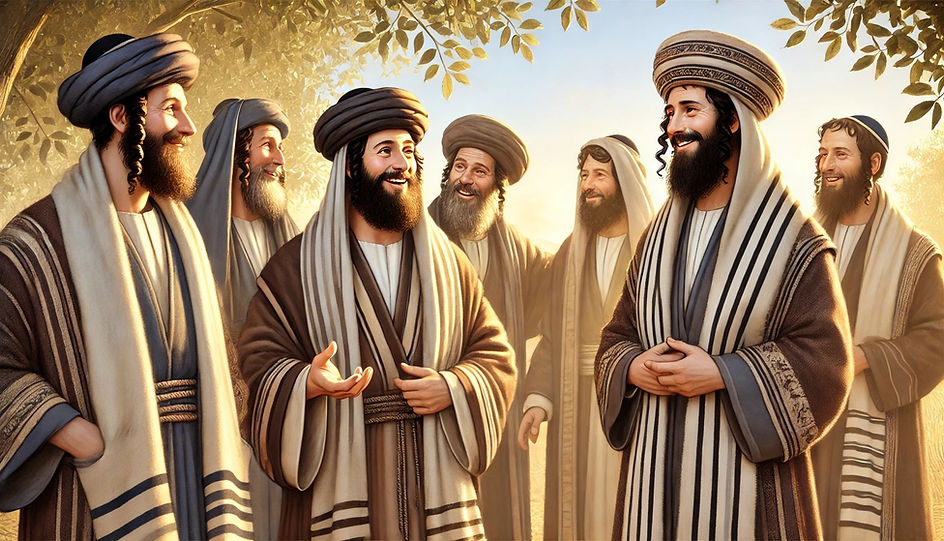
Chapter 11 Pharisees vs. Non-Jews
This chapter contrasts the way Yeshua was treated by Pharisees and Jewish leaders with the way Roman and other non-Jewish authorities treated him. It highlights Pharisees inviting Yeshua to meals, warning him about Herod, defending legal procedure, and honoring his burial. By contrast, it emphasizes that flogging, mockery, and execution were carried out under Roman authority.
It has always mystified me that, based on the image of the Romans of Yeshua's day and the image of the Jewish leaders, anyone would think that these leaders could convince the Romans to do... anything!!!
Read the Gospels and Acts with a steady eye, and you’ll notice something that Christian teachings often blur. Yeshua's arrest, scourging, mockery, and execution are unmistakably non-Jewish. Yeshua's debates with his Jewish brethren are family squabbles. But let's get back to how he is treated by his brethren in contrast to how he is treated by non-Jewish people.
First, hospitality and open doors. Luke records multiple scenes where Pharisees invite Yeshua to their tables (Luke 7:36; 11:37; 14:1, CJB). In Jewish life, a shared meal was not a trapdoor; it was a forum. Around the table, words are tested, motives are read, and ideas are sharpened. Even when the dialogue was pointed, the very invitation signals that Yeshua was someone who belonged.
Second, protective concern. One of the most surprising and ignored lines for some Christians is in Luke, which comes from Pharisees who warn him: “Get out and go away from here, because Herod wants to kill you” (Luke 13:31, CJB). Disagreement did not cancel kinship. Whatever their questions, these Pharisees acted to keep him alive.
Third, legal caution and public integrity. Nakdimon (Nicodemus), a Pharisee and leader, approaches Yeshua as a serious teacher (John 3:1–2). Later, he appeals to due process: “Does our Torah judge a man before hearing him and knowing what he is doing?” (John 7:50–51). After the execution, he honors Yeshua’s burial with costly spices (John 19:39). Likewise, in Acts, Gamliel, a respected Pharisee and Torah-teacher, urges restraint toward the emissaries (Acts 5:34–39), and Acts openly notes that some believers came from the Pharisee sect (Acts 15:5).
By contrast, the non-Jewish side of the narrative is blunt. Pilate orders a flogging and then hands Yeshua over (John 19:1–16). non-Jewish soldiers mock, strike, and brutalize him (Matt 27:27–31, CJB). Herod Antipas and his soldiers treat him with contempt (Luke 23:11). The execution itself is a non-Jewish sentence carried out by a non-Jewish person’s authority. Crucifixion was a non-Jewish tool.
When the text is allowed to speak in full, Pharisaic scenes repeatedly show access, warning, and legal restraint, while non-Jewish people supply the whip, the robe of ridicule, and the stake. This contrast is not a side note; it is the plotline hiding in plain sight.

I have just started on the "Who Were the Pharisees" book. I am 76 years old, which isn't very impressive on a resume. Donations of any amount would be appreciated! An introduction to a pro bono attorney to help obtain 501(c)(3) status would be greatly appreciated.